
Implants vs Dental Bridges: Daily Life and Care
Click to rate this post!
[Total: 1 Average: 5]
Once you have decided on an implant or a bridge, the question people ask most is how it will work in everyday life and what care it needs. Both are fixed restorations and are not taken in and out; however, they are cleaned differently and the points to watch out for are not the same.
In this article we explain how the two options differ in daily use, how to care for them at home, how often to have check-ups and which signs mean you should contact the clinic. To find out which option suits you, see our article bridge or implant; for long-term outcomes, see our article on long-term results.
How Do They Feel in Everyday Life?
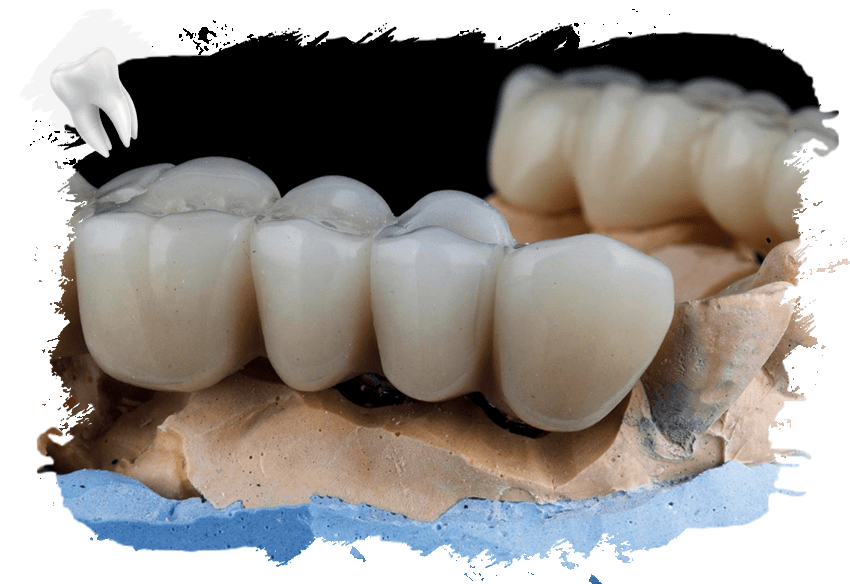
A crown on an implant behaves like a tooth that stands on its own, so floss can be passed between it and the neighbouring teeth. A bridge, on the other hand, is a single-piece structure made up of the supporting (abutment) teeth and the artificial tooth between them; for this reason normal floss cannot pass between the teeth, and the area under the bridge is cleaned with special aids.
Patient satisfaction is high with both options. In a systematic review of single crowns, satisfaction was 89.6% with implant-supported crowns and 94.4% with tooth-supported crowns, and the difference was not statistically significant (Wittneben et al., 2023). There is, however, no strong systematic review that directly compares the two options for chewing and comfort. What affects satisfaction most is whether or not problems occur after treatment (Sailer et al., 2022).
How Do You Clean a Bridge?
The main risk with bridges is decay developing at the crown margin of the abutment teeth; in 5-year data, decay was reported in 1.4% of abutment teeth (Pjetursson et al., 2015). This is why the edges of the bridge and the area underneath it should be cleaned every day:
- Brush twice a day with a soft brush and fluoride toothpaste, holding the brush at an angle to the gum line.
- Clean under the artificial tooth with a floss threader or a special floss with a thick end.
- Use an interdental brush of the right size for the side surfaces of the abutment teeth.
- If your manual dexterity is limited, a water flosser can help.
The guideline led by the American College of Prosthodontists recommends that patients with tooth-supported fixed restorations brush twice a day and use aids such as floss, water flossers or interdental cleaners (Bidra et al., 2016).
How Do You Clean an Implant?
An implant cannot decay, but the gum and bone around it can become inflamed. Inflammation of the gum around an implant (mucositis) is considered the forerunner of the more serious condition peri-implantitis; if mucositis is spotted early it can be reversed, although healing may take longer than three weeks (Berglundh et al., 2018).
- Brush the implant crown twice a day, just like a natural tooth.
- Clean between the implant and the neighbouring teeth with floss or an interdental brush of a size suitable for implants.
- With bridges on implants or full-arch prostheses such as All-on-4, the area under the prosthesis is cleaned with a water flosser and special brushes.
- If you notice bleeding, swelling or a bad taste when brushing, contact the clinic without waiting for your check-up appointment.
Check-ups: How Often?
Scientific guidelines recommend that patients with tooth-supported as well as implant-supported restorations see a dentist for a check-up at least every six months for life, and that people at higher risk be seen more often (Bidra et al., 2016). The European Federation of Periodontology also recommends that the check-up interval for implant patients be set according to each person’s risk factors (Herrera et al., 2023).
Regular maintenance makes a big difference: in a study following patients with inflammation of the gum around their implants, the rate of peri-implantitis developing within 5 years was 18.0% in those who attended regular maintenance and 43.9% in those who did not (Costa et al., 2012; cited in Salvi and Zitzmann, 2014). At check-ups, gum pockets are measured, plaque and tartar are removed, X-rays are taken if needed and your bite is checked.
Chewing, Speech and Aesthetics
With both options there may be a short adjustment period in the first few days while your tongue and cheeks get used to the new teeth. Hard or very sticky foods should be eaten with care, as they can make it easier for the porcelain to fracture or the crown to loosen.
At the front of the mouth, the aesthetic result depends on how the artificial tooth sits against the gum with a bridge, and on the gum and bone structure around the implant with an implant. For this reason, both options are planned for front teeth with the gum line in mind.
Habits That Shorten Their Lifespan
- Smoking: The risk of implant loss is about 2.4 times higher in smokers (Mustapha et al., 2022); smoking also speeds up gum disease.
- Clenching and grinding: These increase porcelain fracture and screw loosening. A night guard is the most effective protection.
- Skipping check-ups: In a long-term follow-up study, more than two thirds of the losses of tooth-supported and implant-supported restorations were caused by biological problems (Bischof et al., 2024). These problems can often be spotted and treated at an early stage.
- Biting hard objects: Hard objects such as pens, seeds and ice can damage the ceramic.
When Should You Contact the Clinic?
If you notice any of the following signs, contact the clinic without waiting for your check-up appointment:
- Bleeding, swelling, discharge or a bad taste in the mouth around the implant or an abutment tooth,
- a feeling that the crown or bridge is loose or moving,
- new sensitivity to hot and cold, or pain, in the abutment teeth,
- a fracture or crack in the porcelain,
- a feeling that your teeth meet differently when you bite.
Most problems that are noticed early can be fixed with simple procedures, which extends the life of the restoration.

Frequently Asked Questions About Implant and Bridge Care
How do you clean under a bridge?
You clean it by passing a floss threader or a special floss with a thick end under the artificial tooth. Interdental brushes and a water flosser also help.
Do I need a special toothbrush for an implant?
An ordinary soft toothbrush is enough. For the spaces between the implant and the neighbouring teeth, an interdental brush of the right size or floss is recommended.
Should I use a water flosser?
A water flosser does not replace brushing, but it can help in hard-to-reach areas such as under bridges and implant-supported bridges.
Can I eat everything with an implant or a bridge?
After the adjustment period you can eat most foods comfortably. Avoiding very hard and sticky foods, and not biting hard objects such as ice and seeds, protects the ceramic.
How often should I come for check-ups?
Guidelines recommend a check-up at least every six months for life. Smokers, people with diabetes and those with a history of gum disease may need more frequent check-ups.
Is bleeding around an implant normal?
No. Bleeding when you brush can be a sign of inflammation of the gum around the implant (mucositis). It can be reversed if treated early, so you should come for a check-up without waiting.
Sources
- Wittneben JG, et al. J Esthet Restor Dent. 2023;35:632-645. doi:10.1111/jerd.12983
- Sailer I, et al. Periodontol 2000. 2022;88(1):130-144. doi:10.1111/prd.12416
- Pjetursson BE, Sailer I, Makarov NA, Zwahlen M, Thoma DS. All-ceramic or metal-ceramic tooth-supported fixed dental prostheses (FDPs)? A systematic review of the survival and complication rates. Part II: Multiple-unit FDPs. Dent Mater. 2015;31(6):624-639. doi:10.1016/j.dental.2015.02.013
- Bidra AS, Daubert DM, Garcia LT, et al. Clinical practice guidelines for recall and maintenance of patients with tooth-borne and implant-borne dental restorations. J Prosthodont. 2016;25 Suppl 1:S32-S40. doi:10.1111/jopr.12416
- Berglundh T, Armitage G, Araujo MG, et al. Peri-implant diseases and conditions: Consensus report of workgroup 4 of the 2017 World Workshop on the Classification of Periodontal and Peri-Implant Diseases and Conditions. J Clin Periodontol. 2018;45 Suppl 20:S286-S291. doi:10.1111/jcpe.12957
- Herrera D, Berglundh T, Schwarz F, et al. Prevention and treatment of peri-implant diseases: the EFP S3 level clinical practice guideline. J Clin Periodontol. 2023;50 Suppl 26:4-76. doi:10.1111/jcpe.13823
- Salvi GE, Zitzmann NU. The effects of anti-infective preventive measures on the occurrence of biologic implant complications and implant loss: a systematic review. Int J Oral Maxillofac Implants. 2014;29 Suppl:292-307. doi:10.11607/jomi.2014suppl.g5.1
- Mustapha AD, Salame Z, Chrcanovic BR. Smoking and dental implants: a systematic review and meta-analysis. Medicina. 2022;58(1):39. doi:10.3390/medicina58010039
- Bischof FM, et al. Clin Oral Implants Res. 2024;35:1640-1654. doi:10.1111/clr.14351
ORAL AND DENTAL HEALTH POLYCLINIC
YOU MAY BE INTERESTED
TREATMENTS THAT YOU CAN RECEIVE

Implant Treatment

Porcelain Laminates

Bonding Application

Orthodontics
Ekiz Oral and Dental Health Polyclinic
We would be happy to help you achieve the smile of your dreams. You can contact us whenever you want.
+90 212 809 47 47
Working Hours: Weekdays 09:00 - 18:00, Weekends 10:00 - 16:00
[email protected]
For any questions and appointments...
Sarıyer/İstanbul
Vadikoru, No:10/A Inner Door No:100
