
Why Were Freddie Mercury Teeth Different?
Click to rate this post!
[Total: 2 Average: 5]
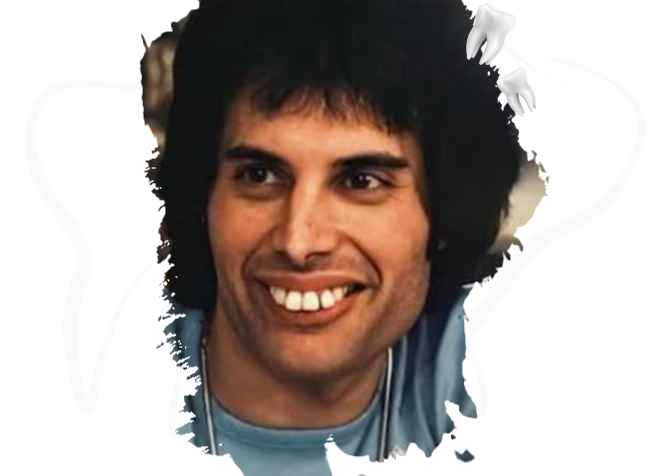
Freddie Mercury teeth were among the most recognisable features of his appearance. His upper front teeth projected noticeably forward, creating a distinctive smile that remained unchanged throughout his career. This appearance was probably influenced by tooth alignment, jaw proportions and reported supernumerary teeth, although an exact diagnosis cannot be confirmed without authentic clinical records.

Why Does Freddie Mercury's Teeth Look Different?
Freddie Mercury’s smile was primarily distinguished by the prominent position of his upper central incisors. These teeth remained highly visible when he spoke, smiled or sang, making them appear more dominant than the surrounding teeth.
Their appearance was not necessarily caused by a single dental condition. The visible difference may have resulted from a combination of increased overjet, incisor angulation, dental crowding and individual jaw development.
Photographs can reveal the general position of the teeth, but they cannot show root alignment, bone structure or the precise relationship between the upper and lower jaws. For this reason, descriptions of Freddie Mercury’s dental condition remain observational rather than diagnostic.
What Was the Condition of Freddie Mercury’s Teeth?
Freddie Mercury was widely reported to have hyperdontia, a condition in which extra teeth develop in addition to the normal number. Accounts indicate that he had four supernumerary teeth in his upper jaw.
These additional teeth were associated with dental crowding and may have contributed to his upper front teeth projecting forward, creating a prominent overbite. Hyperdontia can affect tooth alignment and the way the upper and lower teeth meet, although Mercury’s exact dental structure cannot be fully assessed without clinical records and X-rays.
His teeth therefore appeared noticeably protruded rather than necessarily damaged or unhealthy. Their distinctive appearance was mainly related to tooth number, position and alignment, and it became one of the most recognisable features of Freddie Mercury’s smile.
Did Freddie Mercury Have an Overbite
Freddie Mercury’s dental appearance is often described as an overbite, but the forward projection of his upper front teeth may be more accurately associated with overjet.
An overbite refers to the vertical overlap of the upper front teeth over the lower front teeth. Overjet, by contrast, describes the horizontal distance between them when the upper incisors extend forward.
Mercury’s upper front teeth appeared noticeably prominent, a feature commonly linked to overjet and dental crowding.
His reported extra teeth, known as hyperdontia, may have influenced this alignment. However, the exact degree of overbite or overjet cannot be confirmed without a clinical examination, dental measurements and diagnostic records.
Did Freddie Mercury Have Extra Teeth?
Freddie Mercury is widely reported to have had four additional teeth in his upper jaw. These are generally described as supernumerary teeth, meaning teeth that develop beyond the normal number.
Most adults have up to 32 permanent teeth, including wisdom teeth. Supernumerary teeth may appear anywhere in the mouth and can vary in size, shape and position.
If Mercury had four additional teeth, they may have occupied space within an already limited upper dental arch. This could have influenced the eruption and position of the normal permanent teeth, including the prominent upper incisors.
However, the exact position and classification of Freddie Mercury’s extra teeth cannot be verified without authentic dental records or radiographs.
What Are Supernumerary Teeth?
Supernumerary teeth are additional teeth that form alongside the normal dentition.
Some closely resemble ordinary permanent teeth, while others are smaller, pointed or irregularly shaped. They may erupt normally, emerge outside the dental arch or remain impacted beneath the gums.
Their effect depends on their location. A small additional tooth may produce no symptoms, while another may interfere with eruption, alignment or root development.
How Can Extra Teeth Affect Alignment?
Additional teeth can influence the way normal permanent teeth erupt.
When the dental arch does not provide enough space, neighbouring teeth may rotate, overlap or emerge outside their ideal positions. In other cases, an additional tooth can block eruption entirely.
The effects are not identical in every patient. Supernumerary teeth may contribute to:
- Dental crowding
- Delayed tooth eruption
- Displacement of neighbouring teeth
- Abnormal tooth angulation
- Changes in the bite
In Mercury’s case, the reported extra teeth may have been one contributing factor rather than the sole explanation for his prominent smile.
What Might Freddie Mercury’s Dental Xray Have Shown?
A dental X-ray could potentially have provided more detailed information about Freddie Mercury’s reported extra teeth, tooth roots and jaw structure. However, no verified dental X-rays appear to be publicly available, so any interpretation remains hypothetical.
If he had hyperdontia, an X-ray might have shown the number, location and orientation of the supernumerary teeth. It could also have helped determine whether they contributed to dental crowding, altered eruption patterns or the forward position of his upper front teeth.
X-rays may also reveal findings that cannot be assessed reliably from photographs, such as impacted teeth, root position, bone levels and the relationship between the upper and lower jaws. Without original radiographs and a clinical examination, Freddie Mercury’s exact dental condition cannot be confirmed.
Which Type of Dental Xray Would Be Most Useful?
A panoramic radiograph would provide a broad view of the upper and lower jaws. It could show:
- Additional or impacted teeth
- Tooth roots
- Jawbone structure
- Missing teeth
- Previous dental treatment
- Areas of possible pathology
A lateral cephalometric X-ray would be useful for measuring jaw relationships, facial proportions and incisor angulation.
Together, these images would help determine whether Mercury’s appearance was mainly dental, skeletal or a combination of both.
Did Freddie Mercury Ever Consider Dental Surgery?
There is no reliable public evidence confirming that Freddie Mercury seriously planned dental surgery. He reportedly chose not to alter his teeth because he believed changing their position might affect his singing voice.
From a clinical perspective, correcting extra or protruding teeth could involve orthodontic treatment, tooth extraction or, less commonly, jaw surgery. However, Mercury’s actual treatment options cannot be determined without verified dental records, X-rays and a professional examination.

Why Did Freddie Mercury Keep His Teeth?
Freddie Mercury reportedly avoided correcting his teeth because he was concerned that dental treatment could affect his singing voice.
Whether treatment would actually have changed his voice is uncertain. The result would have depended on the procedures performed, the amount of tooth movement and how his tongue and lips adapted afterward.
His teeth also became part of his public identity. Their prominent appearance contributed to his expressions and made his face instantly recognisable.
Correcting them could have changed more than alignment. Retracting the upper incisors might also have affected lip support, smile width and facial profile.
Would Orthodontic Treatment Have Changed His Singing Voice?
Orthodontic treatment can temporarily affect speech and oral sensation.
Braces, aligners and retainers alter the surfaces that the tongue contacts. During the adaptation period, some patients notice minor changes in pronunciation, particularly with sounds such as ‘s’, ‘t’ and ‘th’.
Singers may also become more aware of subtle changes in tongue position or airflow. However, these effects are usually temporary.
The fundamental singing voice is generated by the vocal folds. Orthodontic treatment does not directly change their structure or function.
Could Tooth Extraction Affect Resonance?
Tooth extraction changes the oral environment temporarily, particularly during healing.
Swelling, discomfort and altered tongue contact may affect articulation for a short period. If orthodontic treatment follows, the gradual movement of the teeth may also change how certain sounds are formed.
Long-term effects on resonance are generally limited because singers can adapt their articulation and oral shaping. The outcome would depend on the location of the extracted teeth, the treatment plan and individual adaptation.
Did Freddie Mercury's Teeth Increase His Vocal Range?
There is no strong scientific evidence that Freddie Mercury’s extra teeth increased his vocal range.
Musical pitch is produced by the vibration of the vocal folds. Vocal range is influenced by:
- Vocal fold length and flexibility
- Laryngeal control
- Breath support
- Muscle coordination
- Training and technique
- Individual anatomy
Teeth help shape sounds after they are produced, but they do not determine the highest or lowest notes a singer can reach.
How Do Teeth Influence Speech and Singing?
Teeth contribute to articulation by guiding airflow and providing contact points for the tongue and lips.
Sounds such as ‘f’, ‘v’, ‘s’, ‘z’ and ‘th‘ depend partly on the position of the front teeth. Significant changes in alignment may temporarily affect how these sounds are pronounced.
In singing, the mouth also acts as part of the vocal tract. Although teeth influence articulation and sound shaping, they do not create vocal power or pitch.
Could Freddie Mercury's Teeth Have Been Fixed?
Freddie Mercury’s tooth alignment might have been improved with orthodontic treatment, extra-tooth removal or restorative dentistry, depending on his actual dental findings.
However, the appropriate treatment could only have been determined through X-rays, bite analysis and a clinical examination. Photographs alone cannot show whether correction was necessary or which option would have been safest.
Could Braces Correct the Protrusion?
Fixed braces can move protruding incisors into a more balanced position.
Before retracting the front teeth, the orthodontist would need to create enough space. This could involve:
- Removing selected teeth
- Moving the back teeth farther backward
- Expanding the dental arch in suitable cases
- Using temporary anchorage devices
- Combining several orthodontic techniques
The movement would need to remain within the supporting bone to protect the roots, gums and long-term stability of the teeth.
Could Clear Aligners Have Worked?
Clear aligners can treat many cases of crowding, rotation and mild to moderate protrusion.
More complex cases may require attachments, elastics or additional orthodontic appliances. If several supernumerary teeth were present, they might need to be removed before aligner treatment began.
Fixed braces may provide more precise control when significant root movement or major incisor retraction is required.
The choice between braces and aligners would depend on the complexity of the case rather than appearance alone.
Would Veneers Have Corrected the Problem?
Veneers could alter the visible colour, shape and proportions of the front teeth, but they would not correct the underlying bite.
Placing veneers on strongly protruding teeth might require extensive enamel reduction. This could create unnecessary risks if the teeth were otherwise healthy.
Veneers would also have no effect on additional teeth or skeletal jaw relationships.
For a case involving significant projection, orthodontic treatment would generally be more appropriate than cosmetic reshaping alone.

Would Jaw Surgery Have Been Necessary?
Jaw surgery is usually considered when a significant skeletal discrepancy cannot be corrected with tooth movement alone.
If Mercury’s dental appearance had been strongly influenced by the position of the upper or lower jaw, combined orthodontic and surgical treatment might have produced a more complete correction.
However, there is not enough clinical information to determine whether surgery would have been necessary in his case.
How Would Dentists Assess Freddie Mercury's Teeth Today?
A modern assessment would begin with a detailed dental and orthodontic examination.
The clinician would evaluate:
- Tooth number and alignment
- Overbite and overjet
- Dental arch width
- Jaw relationships
- Gum and bone health
- Tooth wear
- Lip support
- Facial profile
- Smile proportions
Digital scans could create accurate three-dimensional models of the teeth. Photographs and X–rays would then be used to understand how tooth movement might affect the smile and profile.
Why Is Facial Profile Analysis Important?
Retracting prominent upper incisors can change the way the lips are supported.
Appropriate movement may improve facial balance. Excessive retraction, however, can flatten the profile or make the lips appear less supported.
Orthodontic planning must therefore consider the teeth, jaws, lips and overall facial proportions together.
The goal would not simply be to make the teeth straight. It would be to achieve a stable bite without creating an unnatural facial result.
Why Does Root Position Matter?
Teeth can only be moved safely within the surrounding bone.
If the roots are pushed too far toward the edge of the bone, the risk of gum recession or reduced bone support may increase. Excessive orthodontic force may also contribute to root shortening.
Radiographs allow orthodontists to evaluate root length, angulation and available bone before deciding how far the teeth can be moved.
What Is the Difference Between Crowding and Protrusion?
Crowding occurs when there is insufficient space for all the teeth to align correctly. Teeth may overlap, rotate or erupt outside the ideal dental arch.
Protrusion refers to teeth that sit or angle farther forward than expected.
A person can have crowded teeth without noticeable protrusion. Another patient may have relatively straight teeth that still project forward.
Freddie Mercury may have displayed features of both, but the two terms should not be used interchangeably.
Were Freddie Mercury's Teeth Unhealthy?
The appearance of Freddie Mercury’s teeth does not prove that they were unhealthy.
Crooked or protruding teeth can remain free from decay and gum disease when they are cleaned effectively. Dental appearance alone cannot reveal the presence of cavities, infections or periodontal problems.
However, certain alignments can make oral hygiene more difficult or increase the risk of accidental injury.
Without verified dental records, it is impossible to determine whether Mercury experienced significant oral health problems.
Can Crowded Teeth Cause Dental Problems?
Crowded areas may be difficult to clean because toothbrush bristles and dental floss cannot easily reach between overlapping teeth.
This may increase the risk of:
- Plaque accumulation
- Tooth decay
- Gum inflammation
- Tartar formation
- Bad breath
The level of risk depends on the severity of the crowding and the person’s oral hygiene habits.
Did Freddie Mercury Have Difficulty Biting or Chewing?
There is no reliable public evidence showing that Freddie Mercury had serious problems with chewing.
Many people with increased overjet retain normal chewing function, particularly when the back teeth meet effectively.
Possible functional effects may include difficulty biting into certain foods or increased pressure on selected teeth. Whether Mercury experienced these issues cannot be determined from photographs.
Are Protruding Teeth More Vulnerable?
Upper incisors that project forward may receive less protection from the lips.
They can therefore be more vulnerable during falls, sports injuries or facial impact. The risk is especially relevant when the teeth extend significantly beyond the lower dental arch.
A custom-made mouthguard can help protect prominent front teeth during physical activity.

Could His Bite Have Caused Tooth Wear?
An uneven bite may place excessive pressure on particular teeth.
Over time, this can contribute to:
- Enamel wear
- Small fractures
- Chipping
- Tooth sensitivity
- Changes in the biting surfaces
However, tooth wear can also result from grinding, acidic foods, ageing and brushing habits. Alignment alone would not confirm the cause.
Could His Teeth Have Affected His Jaw Joints?
Jaw joint symptoms have many possible causes, including muscle tension, stress, grinding and individual joint anatomy.
An increased overjet does not automatically cause temporomandibular joint problems.
There is no verified evidence showing that Freddie Mercury experienced jaw joint disease related to his dental alignment.
How Did Freddie Mercury's Teeth Shape His Smile?
Freddie Mercury’s upper incisors remained visible even when his lips were only slightly apart.
During singing, speaking and smiling, the front teeth became an important part of his expressions. Their position may also have influenced the resting shape and movement of the upper lip.
The result was a highly recognisable smile that remained consistent throughout his public career.
Why Were His Front Teeth So Noticeable?
Forward-positioned teeth are visible from a wider range of angles.
They may catch more light in photographs and remain exposed during speech. If the surrounding teeth are positioned farther inward, the contrast becomes even stronger.
Mercury’s energetic facial expressions further emphasised the visibility of his upper incisors.
Cosmetic Dentistry and Natural Identity
Modern cosmetic dentistry can improve tooth alignment, colour, shape and bite function. However, treatment does not always need to remove every distinctive feature.
A smile should be assessed in relation to the entire face. Teeth that appear imperfect when examined separately may still harmonise with a person’s lips, expressions and facial proportions.
Freddie Mercury’s smile illustrates why dental treatment should balance health, function, aesthetics and personal identity.
Should Every Irregular Smile Be Corrected?
Not every dental irregularity requires treatment.
Correction may be recommended when tooth position causes:
- Cleaning difficulties
- Repeated dental trauma
- Gum problems
- Tooth wear
- Biting difficulties
- Pain or functional limitations
When the concern is purely cosmetic, the decision should reflect the person’s preferences rather than a universal standard of perfection.
Can Distinctive Teeth Still Look Attractive?
Dental attractiveness is not defined by symmetry alone.
Facial proportions, lip movement, expression and confidence all influence how a smile is perceived. Slight irregularities may add individuality and recognisable character without compromising oral health.
A technically perfect smile is not automatically the most natural-looking result for every face.
Common Myths About Freddie Mercury's Teeth
Freddie Mercury’s teeth have become the subject of several frequently repeated claims.
Some are based on plausible dental principles, while others exaggerate the influence of teeth on singing and vocal ability.
Separating observation from speculation is important because no complete set of verified dental records is publicly available.
Myth: His Extra Teeth Created More Space in His Mouth
Additional teeth generally occupy space rather than create it.
If Mercury had four supernumerary teeth, they may have reduced the room available within his upper dental arch. This could have contributed to displacement of the normal teeth.
The idea that extra teeth created a larger resonating chamber is not supported by standard dental anatomy.
Myth: His Teeth Directly Created His Vocal Range
Teeth influence articulation and sound shaping, but they do not generate pitch.
Freddie Mercury’s vocal range depended primarily on his vocal folds, breath control, laryngeal coordination and technique.
His dental anatomy may have influenced the way certain sounds felt or were articulated, but it cannot fully explain his singing ability.
Myth: Removing the Teeth Would Have Ruined His Voice
Routine tooth extraction is not generally expected to permanently damage a person’s singing voice.
Temporary changes in speech, oral sensation or tongue movement may occur during healing and orthodontic treatment. Most patients adapt over time.
No one can know exactly how Mercury would have responded, but permanent loss of vocal ability would not have been an inevitable outcome.
Freddie Mercury's Teeth and Modern Orthodontic Planning
A patient with similar dental characteristics would receive an individualised treatment plan.
The first stage would involve identifying any supernumerary teeth and determining whether they were interfering with the permanent dentition.
The orthodontist would then evaluate the available space, jaw relationship, gum condition and facial profile before selecting the safest approach.
Possible treatment options could include:
- Fixed braces
- Clear aligners
- Removal of selected supernumerary teeth
- Carefully planned premolar extraction
- Temporary anchorage devices
- Corrective jaw surgery in severe skeletal cases
How Long Could Similar Treatment Take?
Treatment time would depend on the degree of protrusion, the number and position of any additional teeth and the amount of movement required.
A relatively straightforward alignment case might take less than two years. A complex case involving extra teeth, significant incisor retraction or jaw correction could take considerably longer.
An accurate estimate would only be possible after a complete examination.
Would Retainers Be Required?
Retainers would be necessary after orthodontic treatment.
Teeth naturally tend to shift after braces or aligners are removed. Patients treated for crowding and protrusion may be particularly vulnerable to relapse.
Long-term retention helps preserve the corrected alignment and bite relationship.
Why Do Freddie Mercury's Teeth Remain a Dental Talking Point?
Freddie Mercury’s teeth continue to attract attention because they combine distinctive dental anatomy with one of music’s most recognisable faces.
His prominent upper incisors may have reflected several related factors, including increased overjet, individual jaw structure and reported supernumerary teeth.
From a dental perspective, the discussion also demonstrates why terms such as overbite, overjet, crowding and protrusion should be used carefully. Each describes a different feature, and none can be diagnosed with certainty from photographs alone.

Frequently Asked Questions
Why Were Freddie Mercury’s Teeth So Prominent?
Freddie Mercury’s upper front teeth appeared to project forward, which made them especially noticeable when he spoke or smiled. This appearance may have been influenced by dental crowding, tooth position and his reported extra teeth.
Did Freddie Mercury Have Extra Teeth?
Freddie Mercury is widely reported to have had four additional teeth in his upper jaw, a condition known as hyperdontia. However, the precise position and clinical effect of these teeth cannot be confirmed without verified dental records or X-rays.
Did Freddie Mercury Have an Overbite?
His teeth are often described as an overbite, but photographs suggest that overjet may be a more accurate term. Overjet refers to the horizontal projection of the upper front teeth, while overbite describes their vertical overlap with the lower teeth.
Were Freddie Mercury’s Front Teeth Larger Than Normal?
His front teeth may have looked larger because they projected forward and were more visible between the lips. Tooth position, neighbouring tooth alignment and facial expression can make central incisors appear broader or more dominant than they actually are.
Were Freddie Mercury’s Teeth Unhealthy?
Prominent or crowded teeth are not necessarily unhealthy. Photographs can show tooth position and general appearance, but they cannot reliably reveal gum health, decay, root condition or bone support.
Could Freddie Mercury’s Teeth Have Been Corrected?
His tooth alignment might potentially have been improved with orthodontics, removal of extra teeth or restorative treatment. The appropriate approach would have depended on X-rays, bite measurements, tooth-root positions and a full clinical examination.
ORAL AND DENTAL HEALTH POLYCLINIC
YOU MAY BE INTERESTED
TREATMENTS THAT YOU CAN RECEIVE

Implant Treatment

Porcelain Laminates

Bonding Application

Orthodontics
Ekiz Oral and Dental Health Polyclinic
We would be happy to help you achieve the smile of your dreams. You can contact us whenever you want.
+90 212 809 47 47
Working Hours: Weekdays 09:00 - 18:00, Weekends 10:00 - 16:00
[email protected]
For any questions and appointments...
Sarıyer/İstanbul
Vadikoru, No:10/A Inner Door No:100
