
What Are the Types of Dental Crowns and Veneers?
Types of Dental Crowns and Veneers
Differences and How to Choose
Crowns and veneers are the general names for restorations placed on teeth that are broken, heavily filled or root-canal-treated, or whose colour and shape are an aesthetic concern. Although the two are often talked about as if they were the same thing, crowns, which encase the whole tooth, and veneers, which cover only the front surface, are very different treatments.
In this article you will find the zirconia, E.max (lithium disilicate), porcelain-fused-to-metal, porcelain veneer, composite and inlay/onlay options, when each one is preferred and how long they have lasted in clinical studies. The right choice does not depend on a single “best” material but on the condition of the tooth, its position in the mouth and your expectations.
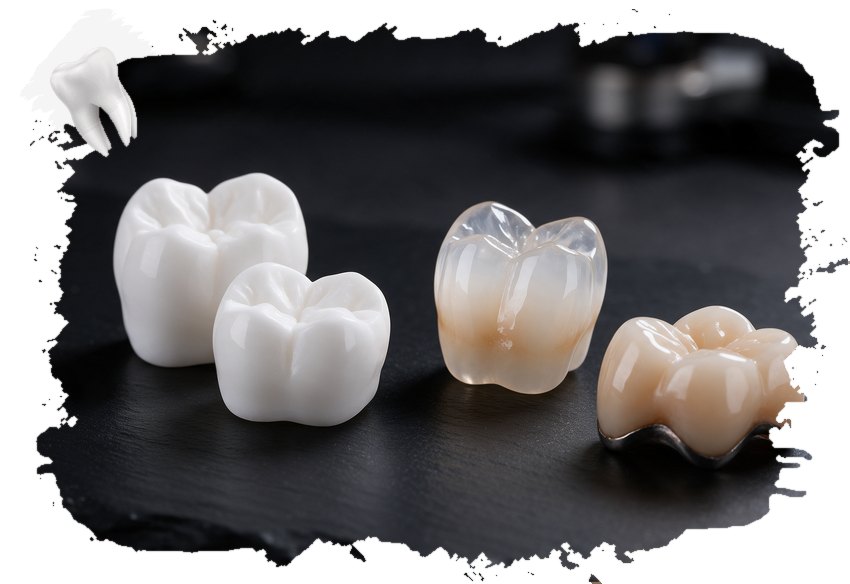
What Are Crowns and Veneers, and When Are They Needed?
A crown or veneer is placed to restore the structure, strength or appearance that a tooth has lost. The main reasons they are needed are:
- Decay too extensive to be repaired with a filling, or old, large fillings,
- broken or cracked teeth,
- teeth that have had root canal treatment and are at greater risk of fracture,
- aesthetic concerns such as wear, discolouration, gaps and irregular shape,
- the supporting teeth of bridges that replace missing teeth, and crowns fitted on implants.
If most of the tooth is healthy and the concern is purely aesthetic, more conservative options (whitening, bonding or veneers) are usually considered first, before a full crown.
Crown or Veneer: What Is the Difference?
A crown (full-coverage restoration) encases the tooth on all sides like a cap. To make room for it, a set thickness of tooth structure is removed from every surface of the tooth. A veneer (laminate veneer), on the other hand, is a thin ceramic layer bonded only to the front surface of the tooth. It usually needs only a small preparation within the enamel layer, and in some cases none at all.
The difference is far from small. In a laboratory study on front teeth, all-ceramic and porcelain-fused-to-metal crown preparations required removal of roughly 63-72% of the natural crown of the tooth, whereas veneer designs removed only about 3-30%; a porcelain-fused-to-metal crown preparation removed 4.3 times more tooth structure than a conventional veneer preparation (Edelhoff and Sorensen, 2002). Values vary in real teeth, but the principle is clear: enamel that has been removed does not grow back.
This is why, for aesthetic work on healthy front teeth, veneers, minimal-preparation or no-prep options are usually preferred, while full crowns are kept for the teeth that genuinely need them.
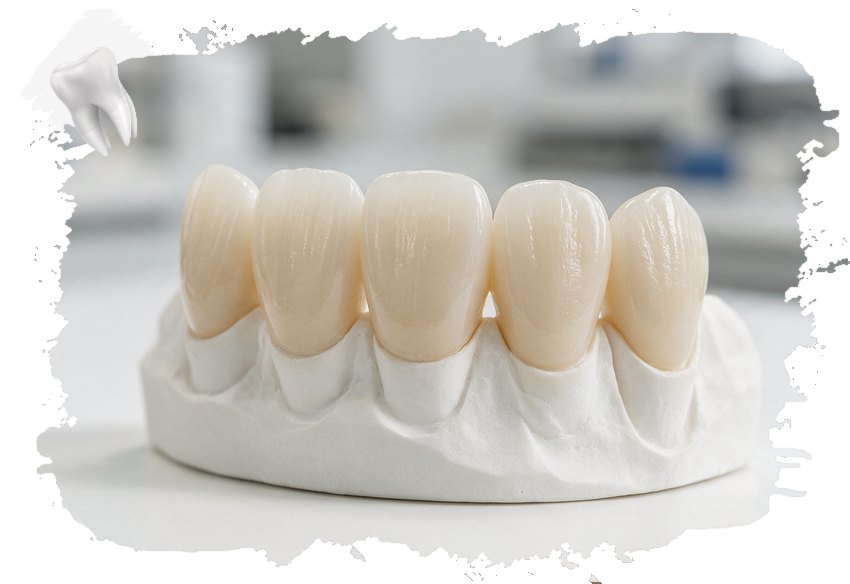
Zirconia Crowns
Zirconia is a metal-free white ceramic with very high strength. It is used in two ways: monolithic crowns, milled entirely from zirconia, and layered crowns, in which porcelain is built up over a zirconia framework. It is often chosen for back teeth, where chewing forces are high, and for bridges and crowns on implants.
In a large systematic review of single crowns, the 5-year survival of zirconia crowns was reported as 93.8% in the correction later published by the authors; this rate was not statistically different from that of porcelain-fused-to-metal crowns (Sailer et al., 2015). The same review identified fracture of the overlying porcelain (chipping) and the crown coming loose as notable problems with layered zirconia. These fractures are markedly less common with monolithic zirconia: in a review of 6,370 restorations, minor fractures (chipping) occurred in 7.1% of layered zirconia and 0.3% of monolithic zirconia (Shihabi and Chrcanovic, 2023).
Zirconia lets less light through than a natural tooth or glass-ceramics; when aesthetic expectations for the front teeth are high, this difference is taken into account in planning. For more details, see our zirconia crowns page.
E.max (Lithium Disilicate) Crowns and Veneers
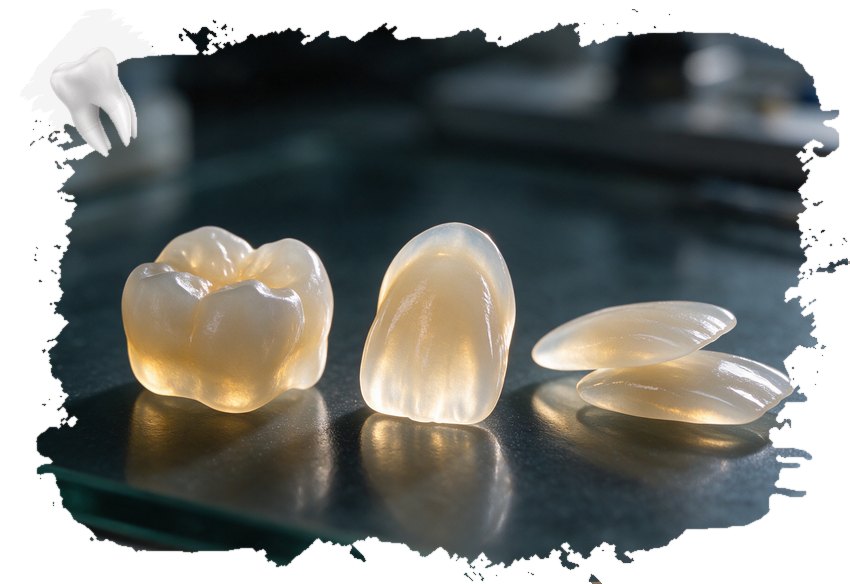
E.max is the well-known brand name of a lithium disilicate glass-ceramic. Because it transmits light in a similar way to natural tooth enamel, it gives a natural look, especially on front teeth. It can be made as a full crown or as a veneer, and it bonds strongly to the tooth using adhesive bonding systems.
In the same systematic review, the 5-year survival of leucite or lithium disilicate glass-ceramic single crowns was 96.6%, with a low porcelain fracture rate of 1.5% (Sailer et al., 2015). In another review of lithium disilicate crowns and bridges, 5-year survival was reported in the range of 95-100% across studies; results for bridges were weaker than for single crowns (AlMashaan and Aldakheel, 2023).
E.max is an option that balances aesthetics and strength on front teeth and premolars. It is generally not chosen for long bridges. For more information, see our E.max crowns and veneers page.
Porcelain-Fused-to-Metal Crowns
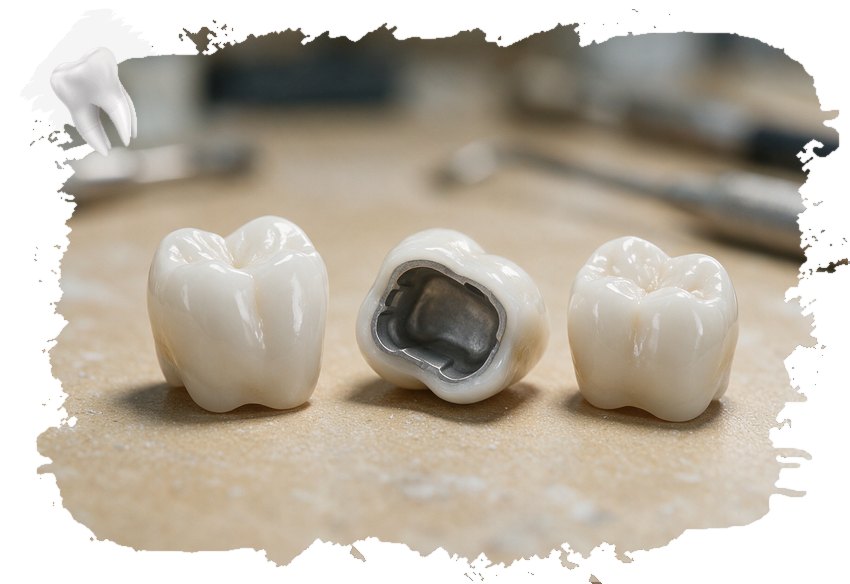
In porcelain-fused-to-metal crowns, tooth-coloured porcelain is layered over a thin metal alloy framework. They have been used in dentistry for decades and are one of the types of restoration whose behaviour is best understood.
In the systematic review, the 5-year survival of porcelain-fused-to-metal single crowns was calculated as 95.7%; the most common technical problem was porcelain fracture, at 2.6% (Sailer et al., 2015). Their aesthetic drawbacks are that the metal may show at the edge of the crown as the gum recedes over time, or that the opaque layer used to mask the metal reduces light transmission (AlMashaan and Aldakheel, 2023). Allergic reactions to metal alloys appear in the literature only at the level of case reports.
For these reasons, all-ceramic options are now used more often on front teeth, while porcelain-fused-to-metal is still a valid option in some cases involving back teeth and long bridges.
Porcelain Veneers (Laminate Veneers)
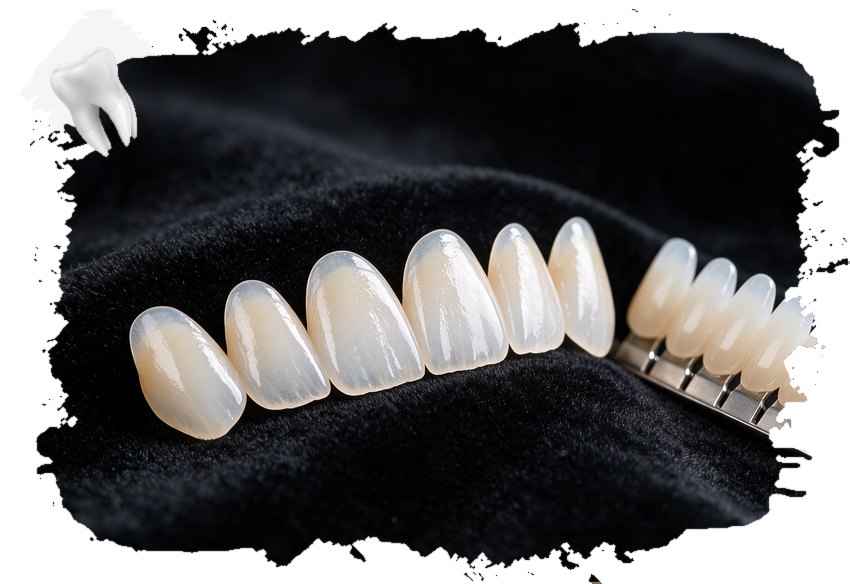
A veneer is a very thin ceramic layer bonded only to the front surface of the tooth. It corrects problems with colour, shape, small gaps and wear while preserving most of the tooth structure. It can be made from hand-layered feldspathic porcelain or from pressed lithium disilicate (E.max).
Long-term results are good. In a systematic review covering 25 studies and 6,500 veneers, 10-year survival was calculated as 95.5% (Alenezi et al., 2021). In a meta-analysis published in 2025, overall survival was 96.05% at a mean follow-up of 10.4 years; the rate of technical problems was markedly lower for lithium disilicate veneers (6.1%) than for feldspathic porcelain (41.48%) (Klein et al., 2025). Veneers bonded to enamel give the best results, while teeth clenching is the main factor that increases the risk of failure.
To find out who they are suitable for, the preparation options and aftercare, take a look at our porcelain veneers page.
Composite Bonding and Composite Veneers
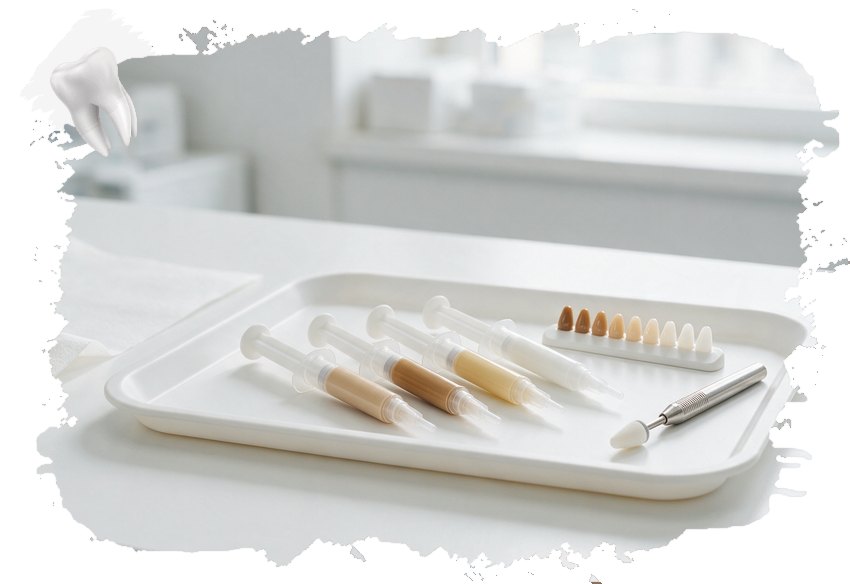
Composite is a tooth-coloured filling material. When it is sculpted directly onto the tooth in the mouth (bonding), it usually requires no tooth reduction and is completed in a single visit. It is a practical solution for repairing a chipped corner, closing small gaps or correcting shape.
The drawbacks of composite are that it stains and wears over time and needs more frequent maintenance and replacement than ceramic. In a 10-year randomised trial comparing composite and ceramic veneers, survival was 75% for composite veneers and 100% for ceramic veneers (Gresnigt et al., 2019). In another study following 1,459 veneers, the annual failure rate at 10 years was 4.1% for composite and 1.2% for ceramic (Mazzetti et al., 2022). On the other hand, composite can be repaired easily.
For how it is done and its limitations, see our composite bonding page.
Inlays and Onlays: Partial Coverage Restorations
If a back tooth has a large filling or a fracture, laboratory-made inlays (which sit inside the tooth) or onlays (which also cover one or more cusps) can be used instead of a full crown to preserve the healthy walls of the tooth. Because a full crown preparation on a back tooth also requires removal of a large part of the tooth structure, these partial restorations are a more conservative option.
In a meta-analysis of 21 studies, the survival of glass-ceramic inlays and onlays was reported as 92% at 5 years and 89% at 10 years, and that of composite ones as 86% at 5 years and 75% at 10 years (Naik et al., 2022). For details, see our inlays and onlays page.
Types of Crowns and Veneers: Comparison Table
| Type of restoration | Which part of the tooth does it cover? | Key feature | Where it is often used |
|---|---|---|---|
| Zirconia | The whole tooth (crown) | High strength, metal-free | Back teeth, bridges, crowns on implants |
| E.max (lithium disilicate) | The whole tooth or the front surface | Light transmission close to a natural tooth | Front teeth and premolars |
| Porcelain-fused-to-metal | The whole tooth (crown) | Many years of clinical use | Back teeth, long bridges |
| Porcelain veneer | The front surface | The ceramic option that preserves the most tooth structure | Front teeth (aesthetics) |
| Composite (bonding) | As much of the surface as needed | Single visit, often with no tooth reduction | Small corrections on front teeth |
| Inlay / onlay | Part of the tooth | Less tooth reduction than a crown | Back teeth with large fillings |
The areas in the table show the general trend; in every case the decision is made after an examination, based on the condition of the tooth and the mouth.
Which Restoration Is Right for Whom?
The main factors that determine the type of restoration are:
- How much healthy tooth structure remains: If most of the tooth is healthy, conservative options such as veneers, inlays or onlays come to the fore. Severely damaged or root-canal-treated teeth may need a crown.
- Position of the tooth: On front teeth, light transmission and a natural look matter more; on back teeth, resistance to chewing forces matters more.
- Clenching and grinding: This habit increases the risk of ceramic fracture. The material is chosen accordingly, and a night guard is often recommended.
- Colour of the underlying tooth: For very dark teeth, materials and thicknesses that can mask the colour are chosen.
- Gum health and bite: If there is gum disease or a bite problem, these are treated first.
- Aesthetic expectations: If the whole smile is to be renewed, planning is done together with an aesthetic dentistry and Hollywood Smile approach.
For example, a zirconia or E.max crown for a broken, root-canal-treated molar, veneers for discoloured but healthy front teeth, and bonding for a small chipped corner on a front tooth are often the first options considered.
The Treatment Process
- Examination and planning: An oral examination is carried out, with X-rays if needed. Any decay, gum disease or need for root canal treatment is dealt with first.
- Preparation: The tooth is prepared by the amount planned for the chosen restoration. This stage is carried out painlessly under local anaesthetic.
- Impressions and temporaries: Impressions or a digital scan are taken, and temporary teeth are fitted the same day if needed.
- Laboratory fabrication and try-in: The restorations are custom-made, and their colour and fit are checked in the mouth.
- Fitting and follow-up: Once approved, the restorations are fixed in place. The bite and how the gums adapt are checked at the next follow-up visit.
Most veneer or crown treatment plans are completed within about 7-10 days, from examination to fitting. The process takes longer when root canal treatment, gum treatment or implants are needed.
How Long Do They Last, and How Do You Protect Them?
In clinical studies, more than 90% of most modern ceramic crowns and veneers are still in use after 5 years, and 10-year survival for veneers is above 95%. These results are averages. What really determines how long a restoration lasts is clenching, oral hygiene and regular check-ups. In veneers followed for up to 20 years, clenching was reported to increase the risk of failure 7.7 times (Beier et al., 2012).
- Brush your teeth twice a day and use dental floss or interdental brushes.
- Avoid biting hard objects (pens, seeds, ice) with crowned or veneered teeth.
- If you clench your teeth, wear a night guard.
- For teeth with crowns or veneers, a dental check-up at least every six months is recommended for life (Bidra et al., 2016).

Frequently Asked Questions About Types of Crowns and Veneers
Which type of crown or veneer is the most durable?
As a material, zirconia is one of the strongest ceramics. However, in clinical studies the 5-year survival rates of modern ceramic restorations and porcelain-fused-to-metal are close to one another. How long a restoration lasts depends as much on the condition of the tooth, clenching and care as on the material.
Is zirconia or E.max the better choice?
Zirconia is often preferred for back teeth, bridges and situations with high chewing forces; E.max is often preferred for front teeth and where natural light transmission is important. The decision is based on the position and colour of the tooth and on the bite.
Do crowns or veneers damage the tooth?
With a full crown, tooth structure is removed from all surfaces of the tooth, and this cannot be reversed. For this reason, on healthy teeth more conservative options such as veneers or bonding are considered first, rather than a full crown for aesthetic purposes. Where it is needed, however, a crown protects the tooth and prevents it from fracturing.
Do crowns and veneers change colour over time?
Ceramic restorations such as porcelain and zirconia do not change colour. Composite, however, can stain over time from factors such as tea, coffee and smoking, and needs periodic polishing.
Can the tooth under a crown or veneer decay?
Yes, decay can develop if plaque builds up at the edge of the restoration and along the gum line. In clinical studies this rate is low, but regular brushing, cleaning between the teeth and check-ups are the way to keep this risk to a minimum.
How many days does it take to get crowns or veneers?
Most crown and veneer plans are completed within about 7-10 days. Bonding is usually finished in a single visit. The process takes longer when root canal treatment, gum treatment or implants are needed.
Sources
- Edelhoff D, Sorensen JA. Tooth structure removal associated with various preparation designs for anterior teeth. J Prosthet Dent. 2002;87(5):503-509. doi:10.1067/mpr.2002.124094
- Sailer I, Makarov NA, Thoma DS, Zwahlen M, Pjetursson BE. All-ceramic or metal-ceramic tooth-supported fixed dental prostheses (FDPs)? A systematic review of the survival and complication rates. Part I: Single crowns (SCs). Dent Mater. 2015;31(6):603-623. doi:10.1016/j.dental.2015.02.011 (Correction: Dent Mater. 2016;32(12):e389-e390. doi:10.1016/j.dental.2016.09.032)
- Shihabi S, Chrcanovic BR. Clinical outcomes of tooth-supported monolithic zirconia vs. porcelain-veneered zirconia fixed dental prosthesis, with an additional focus on the cement type: a systematic review and meta-analysis. Clin Oral Investig. 2023;27(10):5755-5769. doi:10.1007/s00784-023-05219-4
- AlMashaan A, Aldakheel A. Survival of complete coverage tooth-retained fixed lithium disilicate prostheses: a systematic review. Medicina. 2023;59(1):95. doi:10.3390/medicina59010095
- Alenezi A, Alsweed M, Alsidrani S, Chrcanovic BR. Long-term survival and complication rates of porcelain laminate veneers in clinical studies: a systematic review. J Clin Med. 2021;10(5):1074. doi:10.3390/jcm10051074
- Klein P, Spitznagel FA, Zembic A, et al. Survival and complication rates of feldspathic, leucite-reinforced, lithium disilicate and zirconia ceramic laminate veneers: a systematic review and meta-analysis. J Esthet Restor Dent. 2025;37(3):601-619. doi:10.1111/jerd.13351
- Beier US, Kapferer I, Burtscher D, Dumfahrt H. Clinical performance of porcelain laminate veneers for up to 20 years. Int J Prosthodont. 2012;25(1):79-85. PMID: 22259802
- Gresnigt MMM, Cune MS, Jansen K, van der Made SAM, Özcan M. Randomized clinical trial on indirect resin composite and ceramic laminate veneers: up to 10-year findings. J Dent. 2019;86:102-109. doi:10.1016/j.jdent.2019.06.001
- Mazzetti T, Collares K, Rodolfo B, et al. 10-year practice-based evaluation of ceramic and direct composite veneers. Dent Mater. 2022;38(5):898-906. doi:10.1016/j.dental.2022.03.007
- Naik VB, Jain AK, Rao RD, Naik BD. Comparative evaluation of clinical performance of ceramic and resin inlays, onlays, and overlays: a systematic review and meta analysis. J Conserv Dent. 2022;25(4):347-355. doi:10.4103/jcd.jcd_184_22
- Bidra AS, Daubert DM, Garcia LT, et al. Clinical practice guidelines for recall and maintenance of patients with tooth-borne and implant-borne dental restorations. J Prosthodont. 2016;25 Suppl 1:S32-S40. doi:10.1111/jopr.12416
ORAL AND DENTAL HEALTH POLYCLINIC
YOU MAY BE INTERESTED
TREATMENTS THAT YOU CAN RECEIVE

Implant Treatment

Porcelain Laminates

Bonding Application

Orthodontics
Ekiz Oral and Dental Health Polyclinic
We are happy to help you achieve the smile of your dreams. You can contact us at any time.
+90 212 809 47 47
Working Hours: Weekdays 09:00 - 18:00, Weekends 10:00 - 16:00
[email protected]
For any questions and appointments...
Sarıyer/Istanbul
Vadikoru, No:10/A Inner Door No:100
